• Skip to primary navigation
  • Skip to main content
  • Skip to primary sidebar
NeuroKnowHow

NeuroKnowHow

Neurodiverse People Who Know How

Menu
  • Home
  • About
    • Close
    • Know about our services
    • Know-how difference
    • Know our experience
    • Know our testimonials
    • Close
  • Know us
    • Close
    • Joseph Aquilina
    • Louise Grimmett
    • Nilsa Abdula
    • Matthew Hancock
    • Victoria Capewell
    • Dr Ross Cooper
    • Dr Elizabeth Capewell
    • Close
  • Our services
    • Close
    • ADHD Coaching
    • Assistive Technology Tutoring
    • Specialist Study Skills Support (SpLD or ASC)
    • DSA Specialist Mentoring (Mental Health)
    • Specialist Mentoring (Autistic Spectrum)
    • Visual Reading course
    • Support for students in Years 10-13
    • Courses & Workshops
    • Close
  • For Needs Assessors
  • Resources
    • Close
    • Information
      • What is Neurodiversity?
      • Adult ADHD Information
      • What is Dyslexia?
      • Dyspraxia & DCD Information
      • DSA Non Medical Helper rates
      • Glossary
    • Questionnaires
      • Adult ADHD questionnaire
      • Adult Dyslexia Questionnaire
      • Adult Dyspraxia Questionnaire
      • Multiple-intelligence questionnaire
    • Freebies
      • Free strategy printouts
    • Policy and Procedures
      • Complaints Policy
      • Complaints Procedure
    • Close
  • News & Blog
  • Connect with us…
    • Close
    • Send us a message
    • Service feedback
    • Login
    • Close
    • Close
    • Close

Dyslexia

The Talking Library

15/10/2012 by brain-e

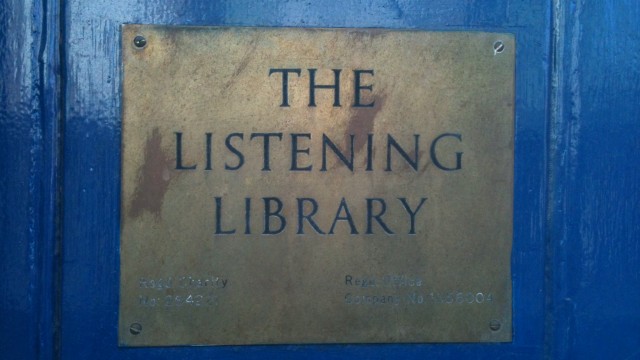
The Listening Library

The day started with a phone call to Fiona Hutchinson, to unfortunately explain that I was stereotypically running late, and a bit disorientated as to where I was supposed to be. After a small amount of anxiety about finding a new place; an approximate ten minute walk from Borough station is where I found the home of a charity called Listen Books.

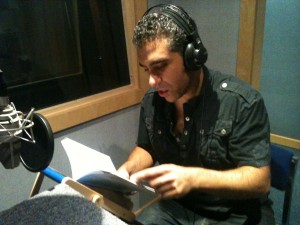
Why am I looking for a book with ears? I was invited by RASP publishing to record the two poems I have published in their audiobook version of the poetry anthology Forgotten Letters. With a large amount of their subscribers being dyslexic, having a visual impairment and other physical disabilities, it was a great opportunity to reach an empathetic audience.

With a bit of help from Jenny as my SatNav on the phone (as my iPhone was on the blink, so I couldn’t use maps). I eventually made it to their door, and was greeted by Fiona Hutcheson the Copyright and Communications Manager, signed in and met the friendly bunch upstairs. I was then swiftly whisked off down stairs to meet Will Parker (using the visual mnemonic “Shakespeare dressed as Spiderman” so I could remember his name). Did a couple of takes and hopefully has a few expletives I made as I stumbled over my words a few times, edited out. The poems recorded were “Where Ya Comin’ From” and “The sWord”.

A great charity that allows people to access the written word where they may have not ever been able to. With Stephen Fry as a patron and The Baroness Warnock DBE as president, I didn’t feel in the slightest a intimidated (yeah right!).
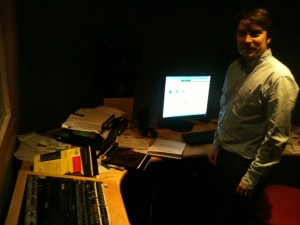
Will Parker Audio Producer (not to be confused with Shakespeare or Spiderman)
Me reciting my works from the book
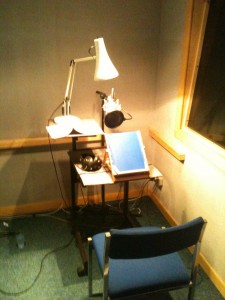
The vocal booth
The vocal booth

Filed Under: Dyslexia, Joseph's Blog, Neurodiversity Tagged With: Dyslexia, RASP publishers

Dyslexic Poetry

08/07/2012 by brain-e


Forgotten Letters

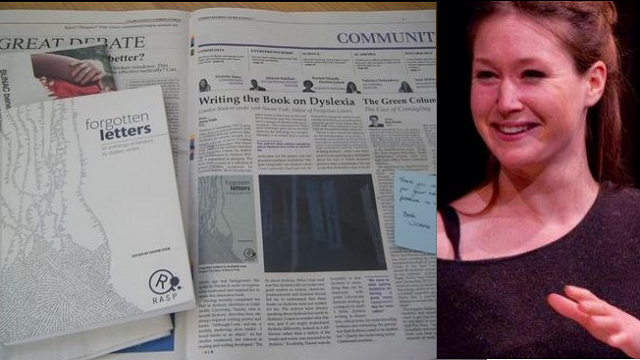
Dr Naomi Folb has worked extremely hard to bring some of the most well known and obscure but brilliant poets together for an anthology. Published by RASP her publishing company, Forgotten letters is the first of it’s kind; a paradox that can be held in the palm of your hand.

There are some notable poets who have got involved included Benjamin Zephania and Philip Schultz. There are are also some lesser known poets who are notable campaigners for positive dyslexia awareness (less of the deficit please), including DYSPLA organiser Alennie Varvaridea and Dr Naomi Folb herself. Not forgetting of course, me with two poems entitled “Where Ya comin’ from” and “The sWord”.

Its available from Amazon too, so get a copy and support and help us boost our self-esteem, and appreciate these Magic Spellers. Oh! and one more thing, when you get a copy it’s not worth trying to read it backwards, back to front or upside-down as that won’t help you understand our holistic dyslexic abstract world, we’ve all “reasonably adjusted” it for the majority, so there’s no excuses.

Filed Under: Dyslexia, Joseph's Blog, Mental Health, Neurodiversity Tagged With: Dyslexia, DYSPLA, Poetry, RASP, writing

Neurodiversity Non-linear thought how School kills creativity

02/03/2012 by brain-e

I thought I would start this blog by talking about where a lot of the difficulties start, looking at the education system. My PG cert thesis 6 years ago, was on dyslexia and creativity; explaining that dyslexic individuals are more likely to be creative, whether in the arts or sciences. To many dyslexia specialists use the term lateral thinking to describe the thought process of people with these different styles: ADDers, dyspraxics, Aspies etc that fall into the Neurodiversity spectrum. Essentially, an individual with executive functioning difficulties would lean away from convergent sequential thought processes and more towards divergent/tangental/holistic thought. The term lateral thinking was coined by Edward DeBono as mentioned I believe in this video (I havent seen it in a while). Lateral Thinking is a process that DeBeno devised to promote creativity amongst convergent/linear thinkers, it is a way to allow a conventional thinker to think out of the box or to think out of the linear way into a new direction… Divergent thinking just happens… like a eureka moment, non-sequential and unpredictable.

The Lateral Thinking process probably works well for sheep who go the same way and can be herded. The education system and society expects everyone to be a sheep, to fit in to the pen or box… but some of us are goats that jump around and is difficult to herd (using Will Self’s analogy for Why prison’s fail), which is why schools fail and why essentially why society fails to be able to deal with people thinking differently. Why just eat grass… when you can eat loads of other stuff. Its funny how the education system and society has to put people into boxes, whether you black, white, brown, dyslexic, ADHD etc…. Then there are those that say… To progress there is the need to think out of the box then why is it then those who think out of the box are the one who are always the first to be excluded in education and society, by failing the education system, being institutionalized and undermined.

Filed Under: ADHD/ADD, Aspergers, Dyscalculia, Dyslexia, Dyspraxia, Mental Health, Neurodiversity Tagged With: ADHD, Creativity, divergent, Dyslexia, education

Despite technology, reading is still a challenge

27/11/2011 by brain-e

This is quite old news really. Text-to-speech software sounds out words through voice syntheses, all very interesting especially if you would like to sell a computer in the 80s.

If you have a problem with auditory processing (a “symptom” of dyslexia and other neurodiversity types), listen to people talking to me can still lead to some confusing alternative understandings of what has been said. This can lead to argument, confusion, laughter and the dyslexia usual suspect “hurdle”, low self esteem.

It is an agreeable article, however one expects there to something more being said about the failure of text-to-speech software with dyslexic users. Our experience is that it is a great tool for proof reading, but for absorbing and understanding new information have a look at the SuperReading course that we provide and what a change it has made in peoples lives. Including the director of NeuroKnowHow Joseph Aquilina. At the start of the coursehe was amongst the lowest 2% of the UK population for reading speed and comprehension. After completing the 8 to 10 week course, he was amongst those who are better than 61% of the population for reading speed and comprehension, and still improving.

In response to

http://timestranscript.canadaeast.com/lifetimes/article/1458953

Filed Under: Assistive Technology, Dyslexia Tagged With: Assistive Technology, Dyslexia, Reading, SuperReading, Technology

Primary Sidebar

Call us…

  (+44) 07971 714 217

News and blog

  • New Report: Supporting students living with ADHD at University: Working better together
  • Embracing My “Attention Difference Hyperdrive” – Brief journey to Self-Acceptance
  • ADHD Meds May Boost Cognitive Skills Long-Term, But Weigh Pros and Cons
  • 1-1 support over the summer (Dyslexia tuition, ADHD coaching, Autism Mentoring, Mental Health) London and Surrey
  • Embracing neurodivergence
  • “Why have I never been taught this before??!”
  • Celebrating Neurodivergent Voices within UAL

About us

  • Know our services
  • Our Know How
  • Know How Difference
  • Know about our services

Design

With an emphasis on typography, white space, and mobile-optimized design, your website will look absolutely breathtaking.

Learn more about design.

ADHD Info & Checklist

ADHD Questionnaire

From a medical perspective, Attention Deficit Hyperactivity Disorder (ADHD) is a neurobiological … Find out more... about Adult ADHD Information

Dyslexia Info & Checklist

Dyslexia Question Logo

Dyslexia people experience difficulty learning to read fluently while maintaining full … Find out more... about What is Dyslexia?

Dyspraxia Info & Checklist

DyspraxiaLOGO

Developmental coordination disorder (DCD), also known as developmental dyspraxia, is a neurological … Find out more... about Dyspraxia and DCD information

Copyright © 2025 NeuroKnowHow Limited ยท Log in