
• Skip to primary navigation
  • Skip to main content
  • Skip to primary sidebar
NeuroKnowHow

NeuroKnowHow

Neurodiverse People Who Know How

Menu
  • Home
  • About
    • Close
    • Know about our services
    • Know-how difference
    • Know our experience
    • Know our testimonials
    • Close
  • Know us
    • Close
    • Joseph Aquilina
    • Louise Grimmett
    • Nilsa Abdula
    • Matthew Hancock
    • Victoria Capewell
    • Dr Ross Cooper
    • Dr Elizabeth Capewell
    • Close
  • Our services
    • Close
    • ADHD Coaching
    • Assistive Technology Tutoring
    • Specialist Study Skills Support (SpLD or ASC)
    • DSA Specialist Mentoring (Mental Health)
    • Specialist Mentoring (Autistic Spectrum)
    • Visual Reading course
    • Support for students in Years 10-13
    • Courses & Workshops
    • Close
  • For Needs Assessors
  • Resources
    • Close
    • Information
      • What is Neurodiversity?
      • Adult ADHD Information
      • What is Dyslexia?
      • Dyspraxia & DCD Information
      • DSA Non Medical Helper rates
      • Glossary
    • Questionnaires
      • Adult ADHD questionnaire
      • Adult Dyslexia Questionnaire
      • Adult Dyspraxia Questionnaire
      • Multiple-intelligence questionnaire
    • Freebies
      • Free strategy printouts
    • Policy and Procedures
      • Complaints Policy
      • Complaints Procedure
    • Close
  • News & Blog
  • Connect with us…
    • Close
    • Send us a message
    • Service feedback
    • Login
    • Close
    • Close
    • Close

brain-e

SuperReading course for Dyslexia

01/03/2012 by brain-e

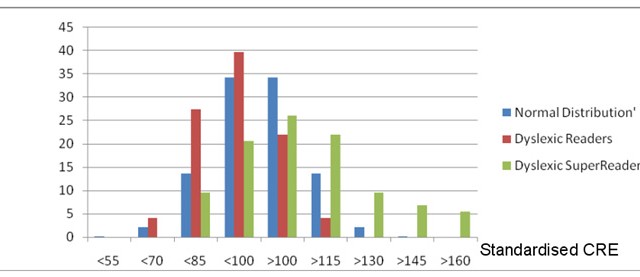
The SuperReading course has been found to improve the reading speed and comprehension of dyslexic people. To the extent that they can eventually become better readers than Non-Dyslexics. So that turns the word dyslexia on it’s head, but being dyslexic it already was upside down. This is what the research by Dr Ross Cooper has found. When I started the course my reading speed was measured and answering questions on what I had read to test my comprehension . My words per minute (WPM) was multiplied by the percentage I got correct in the comprehension. This is then interpreted as a Reading Effectiveness (RE) Score.  My RE Score at the beginning on the course was in the bottom 2% of the population, which isn’t great. However, after I completed the course my RE Score was better than 61% of the population. I was disappointed at first, but Ross pointed out that it’s actually better than most teachers.
Standrd-CRE

It took me a while to complete this course, not because I found it hard… the fact is you cant find it hard, a bit of a brainstrain, but hard no. I was part of the dyslexia control group when it is was first brought to LLU+ (an adult learning centre, which used to be…) part of London South Bank University. It was just when my first child was being born, so in amongst the studying, running a business, nappies, crying, puking, sleepless nights (that was all just me) practicing the EYE-HOP™ technique was too much to handle. The second time it was being run and I had the opportunity to do the course my second child was being born. So the SuperReading course improves reading, or as I found out both reading and fertility.

When I referred “brainstrain”, I feel during the practice of the EYE-HOP™, it feels like you are literally training your brain to read in a different way. SuperReading is a course that has been created by Ron Cole. A reading guru, inventor, coach, entrepreneur; what ever you want to call him he is generally a great guy, who wants to help people in improving their lives and how they feel about them selves. I believe he has helped me and many others (including Ross Cooper who is also dyslexic), to be really DYSatisfied with how we are taught to read at school.

Student Finance England have been paying for the course for students in Higher Education who are dyslexic and also for those who have other difficulties that relate to concentration and comprehension during the reading process.


Dyslexia SuperReading Course

Filed Under: Courses, Dyslexia, Joseph's Blog, Neurodiversity

ADHD makes you feel Marooned? …you’re not alone

03/12/2011 by brain-e

Rory and Marooned

Adam Levine the lead singer from US band Maroon 5 came out about being ADHD, back in June this year. He has since also made adverts for medication that is licensed in the US. ADHD is something that is definitely misunderstood in the UK, it is still mainly associated with children that misbehave in class and who through things at teachers and are more likely to be violent and aggressive to their peers. This in some cases is the case, but this idea is what comes from the media and documentaries that have been shown on TV.

Another celebrity that has come out about being ADHD is the UKs impressionist Rory Bremner. This was done through a radio program entitled ADHD and ME, originally broadcast on Mon 23 May 2011. This documentary was really interesting, as it allowed you to hear the different perspectives of people who choose to medicate and those who do not. Sometimes however even if you choose that you want to get medicated, it can take a long while.

At the time of the broadcast for the Bremner program, there was a years waiting list at the Maudsley Hospital London. At the time of this post it has gone down to 9 months. Still, after the full diagnosis, and you require CBT specifically for ADHD along with medication, due to other mental health issues that can be a result of many years of not having a diagnosis; then your in for another years wait. Come on UK Gov!!! Stop spending money on wars, and fancy cars for MPs, spend the money on the NHS and Education. That way the UK can be healthy and educated and the minority of people who are neurodiverse, don’t have their lives thrown in the bin; as they may have ended up in prison or another institution for essentially thinking differently. How many of these people who have ended up excluded in these ways, could have been those who have found and included themselves by finding and utilizing their talents.

Filed Under: ADHD/ADD, Joseph's Blog, Mental Health, Neurodiversity

Despite technology, reading is still a challenge

27/11/2011 by brain-e

This is quite old news really. Text-to-speech software sounds out words through voice syntheses, all very interesting especially if you would like to sell a computer in the 80s.

If you have a problem with auditory processing (a “symptom” of dyslexia and other neurodiversity types), listen to people talking to me can still lead to some confusing alternative understandings of what has been said. This can lead to argument, confusion, laughter and the dyslexia usual suspect “hurdle”, low self esteem.

It is an agreeable article, however one expects there to something more being said about the failure of text-to-speech software with dyslexic users. Our experience is that it is a great tool for proof reading, but for absorbing and understanding new information have a look at the SuperReading course that we provide and what a change it has made in peoples lives. Including the director of NeuroKnowHow Joseph Aquilina. At the start of the coursehe was amongst the lowest 2% of the UK population for reading speed and comprehension. After completing the 8 to 10 week course, he was amongst those who are better than 61% of the population for reading speed and comprehension, and still improving.

In response to

http://timestranscript.canadaeast.com/lifetimes/article/1458953

Filed Under: Assistive Technology, Dyslexia Tagged With: Assistive Technology, Dyslexia, Reading, SuperReading, Technology

Mary Colley Rest in Peace

27/11/2011 by brain-e

Mary Colley was an educator, a humanitarian and visionary; who believed that the holistic acceptance of all kinds of people was a mission and a passion. Mary Colley who founded the Charity DANDA (the Developmental Adult Neuro-Diversity Association) died on the 22nd September 2010. This was an extremely sad day for those who had discovered who they were from meeting Mary, and found a place for simultaneous solace and celebration.

Mary will be greatly missed as she was a hard worker, a source of inspiration, energy and knowledge. If it was not for Mary I may have not found out that I was ADHD. With her empathy and being able to recognize me “Scanning” (Looking around the room) and swinging on my chair, and flicking bits of paper at my peers during one of her lectures; my life now may be very different.

I believe that I am not the only person who she has had a profound affect upon in their lives, but I thought I should share it. When I thought a life long friend had walked into my life, those footsteps became echos, and knowledge to all of us who work and live with the ideology that is the acceptance of Neurodiversity.

MC

Filed Under: ADHD/ADD, Aspergers, Dyscalculia, Dyslexia, Dyspraxia, Joseph's Blog, Mental Health, Neurodiversity

  • « Go to Previous Page
  • Page 1
  • Interim pages omitted …
  • Page 3
  • Page 4
  • Page 5

Primary Sidebar

Call us…

  (+44) 07971 714 217

News and blog

  • New Report: Supporting students living with ADHD at University: Working better together
  • Embracing My “Attention Difference Hyperdrive” – Brief journey to Self-Acceptance
  • ADHD Meds May Boost Cognitive Skills Long-Term, But Weigh Pros and Cons
  • 1-1 support over the summer (Dyslexia tuition, ADHD coaching, Autism Mentoring, Mental Health) London and Surrey
  • Embracing neurodivergence
  • “Why have I never been taught this before??!”
  • Celebrating Neurodivergent Voices within UAL

About us

  • Know our services
  • Our Know How
  • Know How Difference
  • Know about our services

Design

With an emphasis on typography, white space, and mobile-optimized design, your website will look absolutely breathtaking.

Learn more about design.

ADHD Info & Checklist

ADHD Questionnaire

From a medical perspective, Attention Deficit Hyperactivity Disorder (ADHD) is a neurobiological … Find out more... about Adult ADHD Information

Dyslexia Info & Checklist

Dyslexia Question Logo

Dyslexia people experience difficulty learning to read fluently while maintaining full … Find out more... about What is Dyslexia?

Dyspraxia Info & Checklist

DyspraxiaLOGO

Developmental coordination disorder (DCD), also known as developmental dyspraxia, is a neurological … Find out more... about Dyspraxia and DCD information

Copyright © 2025 NeuroKnowHow Limited · Log in