
Back in October I attended a showing of a film called Thou Art. The film was part of a project of the same name which was a collaboration between South London & Maudsley NHS Foundation Trust and University of the Arts London, funded by the Arts Council England and the South London and Maudsley Charitable Trust. Individuals who have a mental health history made the film itself and the art within it, this included the direction of the film, the music and the artists who are interviewed in the film.
The film explores how each artist makes their work and the barriers they encounter as individuals with mental health issues and as individuals who have this innate need to create. Through interview and being able to view their artwork as the film progresses, you obtain an idea of how important this urge to create art is to these individuals as artists, as human beings and as therapeutic practice and the need to survive through the creativity and its process, as well as the need to survive in the world we live today.
Thinking differently
Before the film screening the director, Jake Stratton explained the background of film and a bit about himself. He explained that he had had a Bi-polar diagnosis (his personal connection to the film’s subject), furthermore, he also saw himself as a creative person, working professionally as an editor in television following studies at London College of Communication, part of the University of the Arts London. He explained that he left school with no academic qualifications eventually finding work in a car maintenance garage.
Fatma
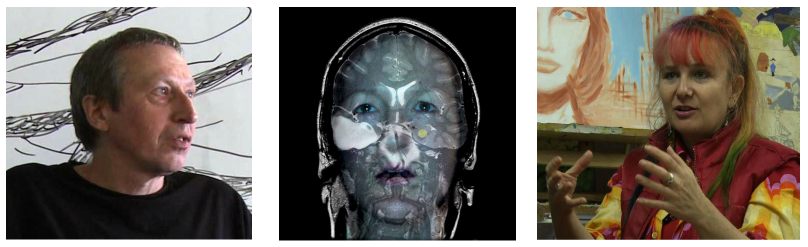
One artist we encounter in the film is named Fatma. She has a diagnosis of Schizophrenia and dyslexia (a co-morbidity from a medical perspective) and explains: “sometimes being dyslexic interferes with learning, being Schizophrenic also interferes with learning”. Another artist expresses how he makes art to express things that he finds difficult to put into word. I ask, ‘is it because what he is trying to express is too abstract for words or is it because he has always had a difficulty with words?’
Deviating from the norm
“Without deviation from the norm, progress is not possible” Frank Zappa
1 in 3 students at the University of the Art’s London are dyslexic . Dyslexia is defined and characterised by a difficulty with working memory, sequential processing and gets its name from difficulties associated with the development of the ability to process language-based information in the way that is expected by conventional schooling and education. In the early years of education the official recognition of an individual as having these difficulties would probably be down to a number of varying factors including financial background and severity of difficulties. However, there are those with an unintentional mask; an underlying ability leading to the development of coping strategies. Recognised by teachers, this underlying ability masked by difficulties can be perceived as laziness, clumsiness, lack of interest or a number of other derogatory labels. This can lead to these individuals having low self-esteem, becoming withdrawn, becoming depressed or angry and frustration expressed through bad behaviour. These metaphors misread by teachers can lead to ridicule or punishment and rejection from their peers. Those who get recognised late in life as adults have probably just struggled to get by; with their underlying ability being ignored and can label themselves with the same derogatory labels they were told as a child; becoming adept at negative self-talk that only decreases their idea of self-worth, in turn affecting emotional aspects of how they understand themselves and how they associate to the world around them. There are similar sequential difficulties that are less obviously detected from poor spelling and poor reading; those who are dyspraxic, with dyscalculia, Aspergers, ADHD or ADD. Many people whose behaviours and difficulties fit the spectrum of difficulties can go undiagnosed until adulthood or their entire life. These adults, like the children above could have the low self-esteem, depression and anxiety which are in themselves considered mental health conditions, this sense of being excluded would obviously affect your mental health. There are of course also those that don’t get recognised at all.
Paul
The need to create
So why the need to create? It’s an esoteric question, repeated it seems in every essay within the book Art and Theory. The same applies to the question that mankind has always asked – Why are we here?
As far as history and anthropology shows us, creating stuff is an intrinsic part of being human. Whether through the need to solve a problem, or just trying to make sense of the human condition and existence, these combinations of neurological processes, emotions, senses and thought are innate. Furthermore, without any of these there is nothing to express: no expression = no creativity.
Creativity has been associated with divergent thinking by psychologists and academics. Sir Ken Robinson has published books and talks about this. A test of using this ability would be to ask someone what can be done with a paper clip and record how many things that person can come up with. It has been said that divergent thinking is a thought process or method used to generate creative ideas by exploring many possible solutions, if you have a problem with sequencing its is possible that your ideas, conversations etc, can go off on tangents in a different direction. This can either get you lost or on an adventure where you find something new, or linking things that usually don’t get linked, or through calculation or chance create new idea or a new thing. This in essence is creativity. People with the above labels and other mental health conditions often have a difficulty with the their working memory. The working memory affects executive function in the brain allowing it to process information in a linear sequential way. If an individual has difficulties with working memory, processing information sequentially presents problems.
Outing the insiders
A person who creates art not having an art school education and indoctrination, may identify themselves as an artist,yet the art establishment is likely to have them labelled as an outsider artist. The term outsider artist has been used to pigeonhole art by the clinically insane. Ironically, there is are a majority of art school school students who have come from white upper or middle-class backgrounds (an elite majority of insiders) who strive to be the cliched art school student: to rebel, to be bohemian. However, the meaning of the word bohemian can be explained as ‘one who has informal and unconventional social habits’. If you look at the synonyms relating to the word bohemian, they can all be related to how society expects people not to be. Being an individual who is neurologically different with or without a diagnosis can make you feel like an outsider, especially as you are more likely to do, smell, taste, see, hear, think, process and feel things differently.
Defining and finding your own personal genius
With a diagnosis of ADHD and dyslexia is the person co-morbid because of who they are and how they are supposed to be, or is it because they are a particular way that doesn’t “fit-in” with what is considered to be the norm. They are in a minority that thinks differently, creatively, holistically, non-sequentially/disorganised, tangentially, divergently.
The above mental states can easily be related to, or attributed to mental health issues and in some respects are on a list of mental health symptoms. This could be a result of how the education system and society expects us to be. If you are predestined genetically to think differently, are you predestined to be an outsider? Relating to Cooper’s Bagatelle Model of Neurodiversity to mental health, the way one thinks will affect the way one feels. If you think like you do not belong, you will more than likely feel like you do not belong. These are thoughts of exclusion, negative thoughts that will have a negative affect on the way the person who is thinking them, chemically and biologically.
It seems that creativity and excellence in any field is admired by most as genius and madness seems to be a common occurrence and almost a cliche. Van Gogh presumed bi-polar is probably the most renowned. It seems that part of being human is mental health and its instability. The other ways of thinking and viewing the world are what lead to new horizons and new ideas. It is the general consensus in contemporary society the we accept people of different cultures and colour of skin, but these are easily noticed through sight and sound. There are hidden subtleties that still seem taboo that are stigmatised and still not accepted as part of the human condition.
I thought I would end this post with some quotes related to the topic…